
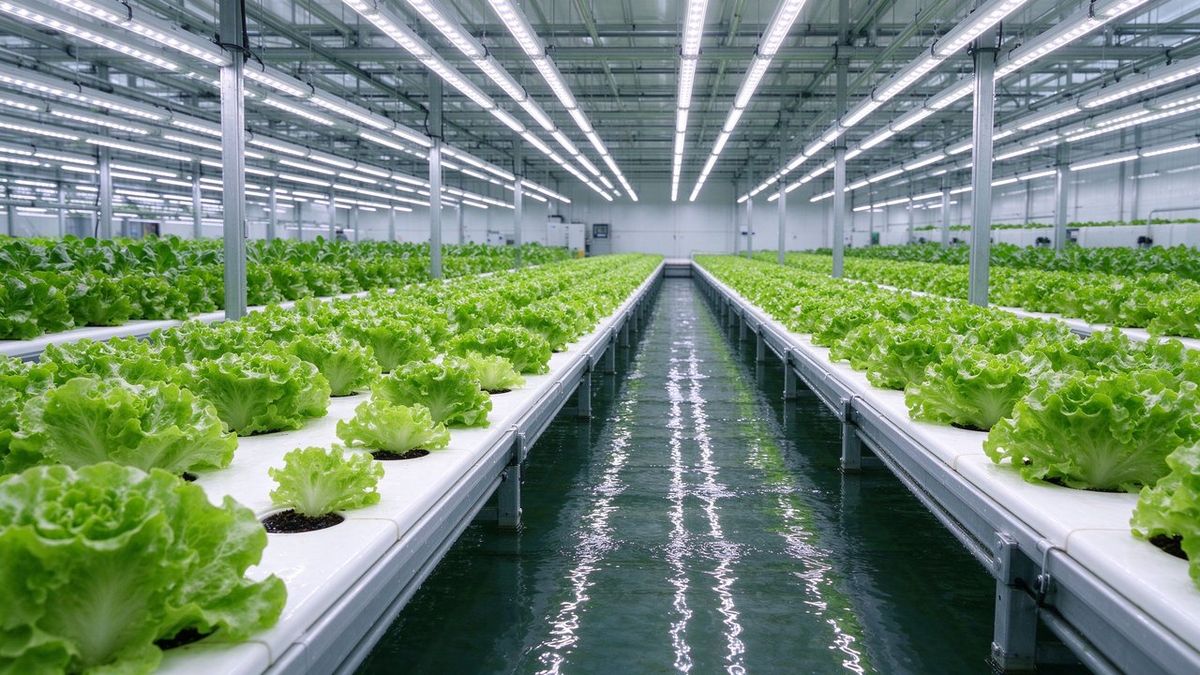
Lettuce is the fastest-turnover protected crop: head lettuce matures in 55 to 65 days from transplant, and loose-leaf cut-and-come-again types are harvested every 14 to 21 days. It is also the most water- and nutrient-efficient greenhouse crop, producing 20 to 30 kg per square meter per year in NFT or substrate culture. The main challenges are tip burn from calcium shortage, bolting under long days, and bottom rot in humid conditions. This article covers the climate, nutrition, and harvest rhythm used at Zhongtian Agricultural Technology for commercial greenhouse lettuce.
Crop Types and Plant Density
Butterhead and crisphead lettuce form tight heads and are harvested whole at 55 to 65 days; they are the mainstay of retail bag and box markets. Romaine forms an elongated head and ships well. Loose-leaf types are harvested by outer leaves on a cut-and-come-again basis every 14 to 21 days for 3 to 4 cuts. Leaf color ranges from green to red and speckled; specialty color mixes command a premium.
Plant density in substrate beds is 12 to 16 plants per square meter for head types, and 20 to 25 plants per square meter for leaf types. In NFT channels, plants are spaced 20 centimeters apart in double rows. Transplants are 20 to 25 days old with 4 to 5 true leaves; do not hold trays beyond 30 days, because root-bound plants bolt prematurely.
Climate Requirements
Lettuce is a cool-season crop: optimum air temperature is 15 to 20 degrees Celsius by day and 10 to 12 by night. Above 25 degrees Celsius, growth is rapid but quality drops: leaves become bitter, tip burn appears, and long days above 14 hours trigger bolting. Ventilate at 22 degrees; shade with 30 percent cloth above 500 watts per square meter. In summer, run cooling pads to keep daytime temperature below 24.
Relative humidity of 60 to 70 percent is ideal. Above 85 percent, bottom rot (Rhizoctonia) spreads on the lower leaves. Horizontal airflow at 0.2 meters per second breaks up humid layers. Night temperature above 15 degrees Celsius causes internal tip burn on head lettuce, because calcium fails to move to the inner leaves. In winter, heat to hold night temperature at 10 degrees; below 5 degrees, growth stops.
Nutrition and Irrigation
The hydroponic recipe for lettuce targets EC 1.5 to 1.8 mS per centimeter and pH 5.8 to 6.2. Macronutrients in millimoles per liter: 10 nitrate-N, 1.0 ammonium-N, 1.0 phosphorus, 4.0 potassium, 3.0 calcium, 1.5 magnesium. Lettuce needs high calcium to prevent tip burn; tissue calcium should read 1.2 to 1.8 percent dry weight. During head formation, add extra calcium nitrate at 0.5 millimole per liter.
Irrigation in NFT runs continuously for 12 hours per day with a 5-millimeter film flowing at 1 liter per minute per channel. In substrate beds, drip pulses of 200 milliliters per emitter every 2 hours during the day. Keep dissolved oxygen above 6 mg per liter. Flush the system with clear water for 30 minutes if EC rises above 2.2.
Tip Burn and Bolting Control
Tip burn is the most common quality failure: dead brown tissue on the inner leaf margins of head lettuce. It is caused by calcium shortage to the inner leaves, which happens when transpiration is low and calcium moves only with water. Prevent it by maintaining air movement at 0.2 meters per second, keeping daytime humidity below 70 percent, and ensuring calcium in the recipe. Foliar calcium nitrate at 0.5 grams per liter, sprayed into the open head at 30 days, reduces tip burn by 70 percent.
Bolting is triggered by long days above 14 hours and night temperature above 18 degrees. In summer, use day-neutral or slow-to-bolt cultivars, and light-shade the crop in the evening to keep day length below 14 hours. Bolting plants elongate the stem inside the head and become bitter; they are culled at harvest. In winter, bolt risk is negligible.
Harvest and Postharvest
Head lettuce is harvested whole by cutting at the base, removing outer damaged leaves, and packing into ventilated cartons. Harvest in the cool morning and cool immediately to 2 degrees Celsius within 1 hour. Lettuce stores well at 1 to 3 degrees Celsius and 95 percent relative humidity for 14 to 21 days. Do not store with ethylene-producing fruit, because ethylene causes russet spotting.
Loose-leaf lettuce is cut at 2 to 3 centimeters above the substrate on a 14 to 21 day cycle. Rinse in cool water, spin-dry to 5 percent surface moisture, and pack in vented clamshells. Bagged baby-leaf mixes are processed within 2 hours of cutting. At Zhongtian Agricultural Technology, year-round NFT beds produce 25 kg per square meter per year with 85 percent Class A yield.
Greenhouse lettuce is a precision cool-crop: 15 to 20 degrees Celsius days, 10 to 12 nights, EC 1.5 to 1.8, and high calcium to prevent tip burn. Head types mature in 55 to 65 days; loose-leaf types are harvested on a 14 to 21 day cycle. When night temperature is held below 12 degrees, air movement keeps humidity under 70 percent, and heads are cooled to 2 degrees within an hour, shelf life reaches 14 to 21 days. Year-round NFT production delivers 25 kg per square meter per year.


