
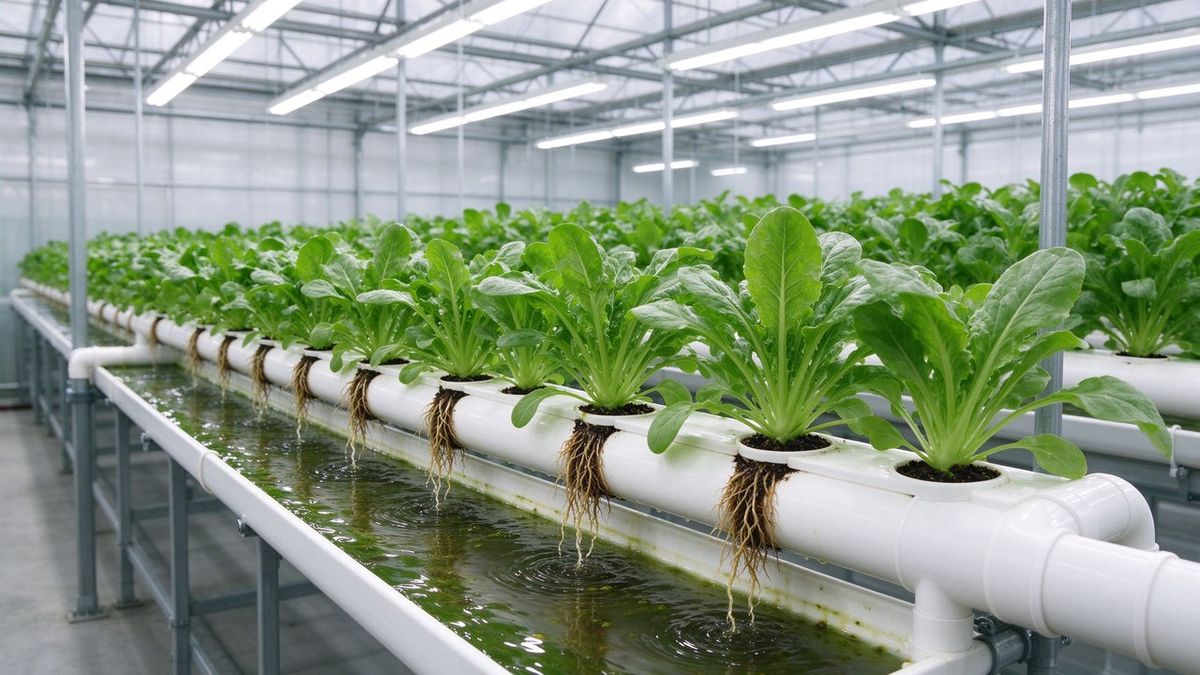
The Nutrient Film Technique (NFT) is one of the most efficient ways to grow leafy greens in a protected greenhouse because it delivers a shallow, recirculating stream of oxygenated nutrient solution directly to a maturing root mat. Unlike deep-water culture, NFT uses only a thin film, typically 3 to 8 millimeters deep, which forces roots to breathe humid air while still taking up water and fertilizer. Done correctly, a well-designed NFT line produces butterhead, romaine, and loose-leaf lettuce at densities of 18 to 25 plants per square meter on a 28 to 35 day cycle. The system rewards precision: channel slope, solution temperature, dissolved oxygen, and electrical conductivity all interact, and a mistake in any one of them shows up as tipburn, root slime, or stalled growth within days.
Channel Geometry and Slope
NFT channels are normally 100 to 200 millimeters wide and built from food-grade PVC or food-grade food-contact plastic, laid on a fall of 1.5 to 3 percent, which equals roughly 15 to 30 millimeters of drop per meter of length. A slope below 1 percent causes pooling and anaerobic zones; above 4 percent makes the film run too fast, drying the roots at the far end. Channel length should not exceed 12 meters in warm climates because solution temperature rises as it travels, lowering dissolved oxygen by the time it reaches the return.
Flow rate per channel is set at 1 to 2 liters per minute for a 100 millimeter gutter and 2 to 4 liters per minute for a 200 millimeter gutter. Beginners often over-pump, which raises film depth and drives roots out of oxygen. Use a 13 millimeter emitter or a gallery feed so each row receives an even share, and check the far-end flow at the end of every shift. A tell-tale of blockage is a dry root mat at the tail end; clean the screen filters weekly and flush the main lines at 10 percent bleach once per crop cycle.
Nutrient Solution Management
Leafy greens are light feeders, so target an electrical conductivity of 1.4 to 1.8 mS/cm during the first ten days and raise it only to 1.8 to 2.2 mS/cm for the final week before harvest. pH must be held between 5.5 and 6.2; above 6.5 iron and manganese lock out, and below 5.2 micronutrients become toxic. Use nitric and phosphoric acid injection rather than sulfuric, because greens need nitrogen in the nitrate form and are sensitive to ammonium spikes above 10 percent of total N.
Keep the nutrient tank at 18 to 22 degrees Celsius. Above 25 degrees Celsius dissolved oxygen falls below 5 mg/L and Pythium risk climbs sharply. Install a venturi or air-stone in the return so dissolved oxygen stays above 6 mg/L. Top off the tank daily with reverse-osmosis water because evaporation concentrates salts; test EC at 08:00 each morning and dump and rebuild the tank every two to three weeks to prevent salt and pathogen buildup.
Crop Scheduling and Plant Density
Transplant lettuce into NFT channels at the two to three true-leaf stage, using 25 to 30 millimeter rockwool plugs or coco coir cubes set into net pots spaced 15 to 20 centimeters apart. Butterhead performs best at 20 by 20 centimeters, romaine at 15 by 20 centimeters, and loose-leaf at 15 by 15 centimeters. A 100 meter bed can hold roughly 500 plants per row across 12 rows, giving a steady weekly harvest when four beds are on a staggered seven-day harvest cycle.
Air temperature should run 18 to 24 degrees Celsius by day and 12 to 16 degrees Celsius at night. Day/night swings above 12 degrees promote compact heads but slow yield; swings below 4 degrees stretch the plants. Keep relative humidity between 60 and 75 percent, and run horizontal air-flow fans at 0.3 to 0.5 m/s across the canopy to prevent localized condensation and botrytis pockets.
Disease and Root-Mat Hygiene
The most common NFT failure is Pythium root rot, which starts as brown, slimy root tips and spreads in four to six days once solution temperature exceeds 24 degrees Celsius. Prevent it by maintaining dissolved oxygen above 6 mg/L, sanitizing channels with 0.5 percent hydrogen peroxide between crops, and removing any dead plugs within 24 hours. Apply beneficial Bacillus amyloliquefaciens or Streptomyces at 10^6 CFU/mL every 14 days as a biological drench.
Fungus gnats and shore flies breed in damp channel covers. Place yellow sticky cards at one per 10 square meter, raised just above the canopy, and replace them weekly. If scouting catches more than 20 gnats per card per week, apply Bacillus thuringiensis israelensis at 50 mg/L into the tank for three consecutive nights when pumps are off. Never apply chemistries through a recirculating tank without flushing, because residues accumulate across cycles.
Harvest and Post-Harvest Handling
Cut heads at the crown with a sanitized knife, dip the cut end in chilled iced water within five minutes, and move to a cooler held at 1 to 3 degrees Celsius. Leafy greens respire rapidly, so every hour at 20 degrees Celsius costs three to four days of shelf life; a packed field box should drop from 18 degrees to 4 degrees within 90 minutes. Add a 200 ppm chlorine or peracetic acid wash only if selling direct-to-market, because excess chlorine browns the cut petioles.
Yield on a mature NFT line typically reaches 3.5 to 5.0 kilograms per square meter per year for loose-leaf and 4.5 to 6.0 kilograms for romaine. Track water use as well: NFT consumes only 2 to 3 liters per kilogram of finished product, compared with 15 to 20 liters in soil culture. Zhongtian Agricultural Technology supplies matched channels, sensors, and fertigation controllers that hold EC within plus or minus 0.1 mS/cm and pH within plus or minus 0.2, which is the practical minimum for consistent commercial NFT.
NFT succeeds when the operator treats slope, temperature, and dissolved oxygen as a single system rather than isolated settings. A disciplined tank-rebuild schedule, weekly sticky-card scouting, and rapid cooling after harvest turn a technically sensitive method into the most water-efficient leafy-green platform available to greenhouse growers.


