
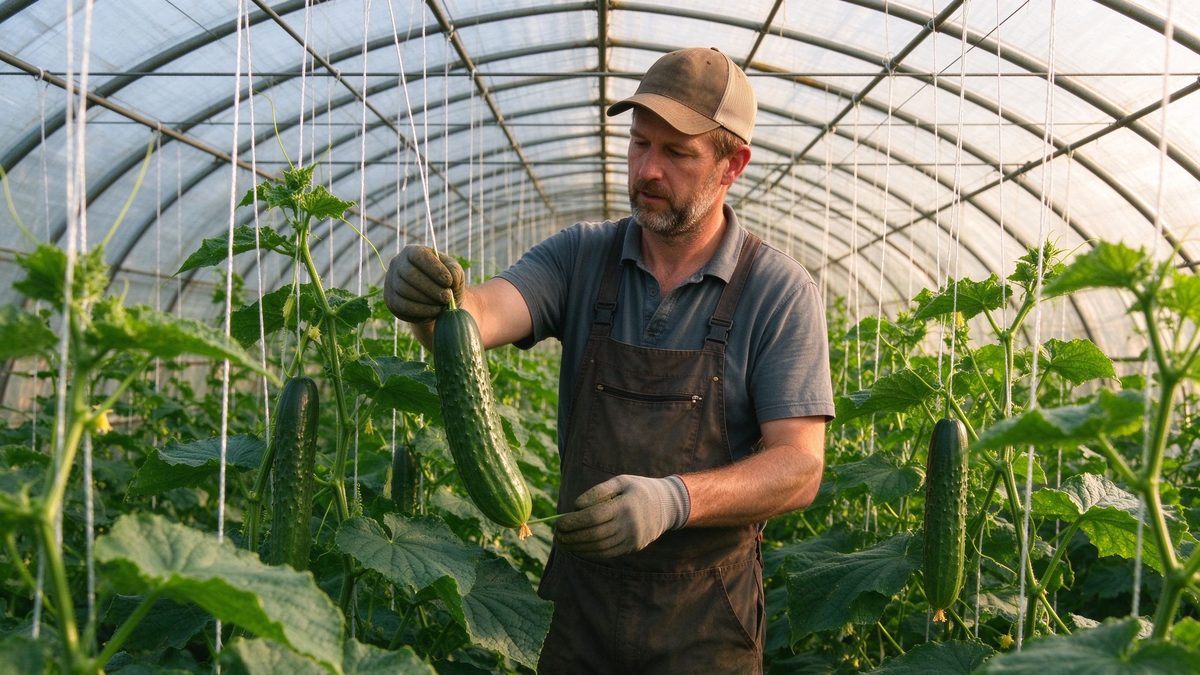
Growing Where Nothing Grows
Large areas of the world cannot support field agriculture: desert, gravel plains, saline coastal flats, and degraded industrial land. Protected cultivation can use these areas productively because the growing environment is constructed rather than inherited.
Regions including the Gulf states, North Africa, Central Asia, and parts of western China have built greenhouse capacity specifically to use non-arable land. The attraction is not only land availability but also abundant solar radiation, which drives photosynthesis when water and climate are controlled.

Water Is the Binding Constraint
On non-arable land, water determines whether production is possible at all. Sources include desalinated seawater, brackish groundwater, and harvested condensate. Each has a different cost and quality profile, and the greenhouse design must match the source.
Closed-loop irrigation is not optional in these settings. Recirculation with disinfection and nutrient rebalancing reduces consumption to a fraction of drain-to-waste practice. Condensation capture from cooling systems and dehumidifiers can supplement supply in humid coastal deserts.
Climate Control in Extreme Heat
Cooling dominates design in hot arid regions. Pad and fan systems work well in dry air but consume large water volumes; high-pressure fogging cools efficiently where humidity is low; mechanical chilling is reliable but energy intensive. Combinations staged by time of day usually outperform any single method.
Shading and spectral management reduce heat load before cooling is needed. External shade nets, whitewash on glass, and reflective screens lower incoming radiation. Selecting the shading level so that light remains adequate for the crop is the central design decision.

Soilless Systems and Salinity
Saline irrigation water makes soil culture impractical. Substrate or hydroponic systems with controlled leaching and recirculation allow production with water quality that would poison soil within a season. Grafted plants onto salt-tolerant rootstocks extend the range further.
Nutrient management becomes a salinity management exercise. Sodium and chloride accumulate in recirculating systems and must be discharged or diverted. Monitoring and controlled bleed are routine operational functions rather than exceptions.
Sandblasting from wind-blown particles abrades film and polycarbonate surfaces over time. In exposed locations, glass or abrasion-resistant polycarbonate lasts longer despite higher initial cost. Structural design must also account for wind loads on large, exposed sites without the shelter that vegetation provides elsewhere.
Dust is a persistent problem in arid regions. Deposits on glazing reduce light transmission by ten to twenty percent within weeks, directly reducing yield. Cleaning schedules, water-efficient cleaning equipment, and glazing choices that resist dust adhesion all matter.
Soil, Dust, and Structural Durability
Hybrid systems that combine solar generation with a small grid connection or generator handle the reliability requirement without oversizing renewable capacity. Cooling and lighting loads, the two largest consumers, should be scheduled against generation availability rather than run whenever convenient.
Greenhouse sites on non-arable land are frequently far from grid infrastructure. Power supply becomes a design driver rather than an afterthought. Diesel generation is expensive and maintenance-intensive; solar photovoltaic with battery storage is increasingly viable where irradiance is high.
Energy Supply in Remote Locations
Production on non-arable land is a demonstration of engineering discipline. Water, cooling, power, and dust must each be solved before planting begins, because in these environments a single unsolved constraint determines the outcome of the entire project. Where the four are addressed together, greenhouses produce reliably in places that conventional agriculture cannot use at all, turning unusable geography into dependable food supply.
Conclusion
Greenhouse production on non-arable land converts unusable geography into food supply, provided water, cooling, and salinity are engineered together rather than separately. Shouguang Zhongtian designs greenhouse systems for arid and saline environments with integrated cooling, recirculation, and substrate growing for reliable production where conventional agriculture cannot operate.


