
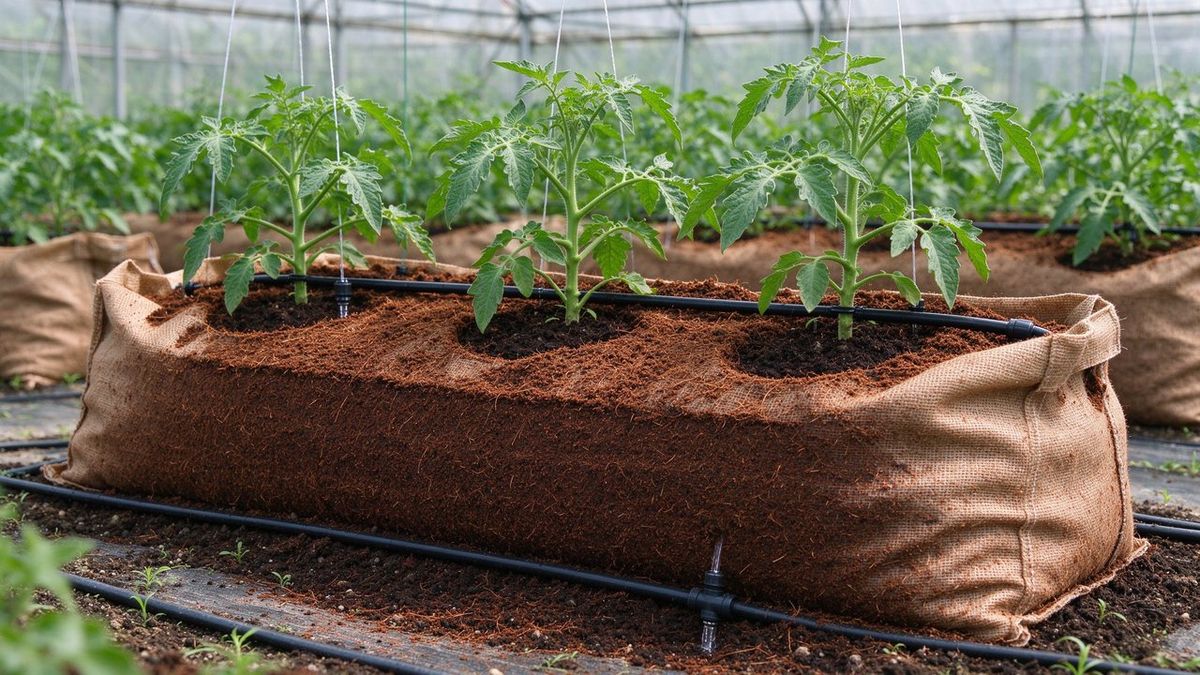
Hydroponic melon production in coco coir, rockwool, or perlite slabs removes soil-borne disease, tightens climate control, and lifts yield to 5.0 to 6.5 kg per square metre per cycle. The system uses a run-to-waste drip irrigation or closed NFT system, with daily EC and pH monitoring. Hydroponic melon commands a 20 to 30 per cent price premium because of uniformity, thin rind, and predictable Brix. The trade-off is higher capital cost and a small team that understands nutrient chemistry.
Substrate Choice and System Layout
Coco coir bags at 10 L volume, two plants per bag, are the dominant system. Coco is buffered before use: soaked in 1.5 EC calcium nitrate solution for 24 hours, then flushed until drainage matches feed EC. Rockwool slabs at 7.5 cm thickness are an alternative, preferred by growers who want precise root-zone temperature control. Perlite bags are cheaper but drain faster and demand more frequent irrigation cycles.
Rows are 1.6 m apart on gullies sloped 1:80. Drainage water is collected in lined channels. In open systems, drainage goes to waste; in closed systems, it is filtered, UV-treated, re-balanced, and reused. Closed systems save 30 to 40 per cent water and fertiliser but require weekly EC and pathogen checks to prevent Pythium buildup. A 1,000 m² hydroponic melon bay uses 1.5 to 2.0 m³ of feed per day at full canopy.
Nutrient Solution and EC Management
A standard melon nutrient recipe per 1,000 L: nitrate nitrogen 160 mg/L, ammonium nitrogen 15 mg/L, phosphorus 40 mg/L, potassium 250 mg/L, calcium 150 mg/L, magnesium 50 mg/L. Trace: iron 2.5 mg/L, manganese 0.8, zinc 0.4, boron 0.3, copper 0.1, molybdenum 0.05. Feed pH is 5.5 to 6.0; EC ramps from 1.5 mS/cm at transplant to 2.6 to 2.8 at fruit swell, and up to 3.0 during sugar loading.
Drainage is checked twice daily. Target drainage EC is within 0.3 mS/cm of feed EC; if drainage climbs above 3.2, the system is flushed with clear water for two cycles. Drainage pH above 6.4 indicates sodium accumulation and triggers an acid flush at pH 4.8. In closed systems, sodium must stay below 1.5 mmol/L; above that, the feed is diluted with fresh water. Weekly nutrient lab analysis of drainage catches element drift before symptoms appear.
Root-Zone Climate
Root-zone temperature is held at 22 to 25 degrees Celsius. Below 18, nutrient uptake slows and phosphorus deficiency appears; above 28, root respiration consumes more oxygen than the medium supplies and roots die back. In winter, root-zone heating pipes at 38 to 42 degrees supply warm water along the gullies. In summer, feed solution is cooled to 22 degrees through a chiller before injection; warm feed above 28 degrees is a common cause of sudden melon collapse.
Oxygen level in the root zone is critical. Coco coir holds 25 to 30 per cent air volume after drainage; rockwool holds 15 to 20 per cent. Irrigation cycles must be short enough that the slab re-aerates between cycles. A cycle that runs too long saturates the medium and suffocates roots. The rule: each cycle lasts 60 to 90 seconds, and at least 2 hours elapse between cycles during the day. Drainage should stop 30 minutes after the cycle ends.
Yield and Financial Model
Hydroponic melon produces 5.0 to 6.5 kg per square metre over an 85-day cycle, compared with 3.5 to 4.5 kg in soil. Three cycles per year are possible in a heated greenhouse. Premium Brix of 12 to 14 degrees is more consistent because EC and water stress are precisely controlled. The hydroponic system pays for itself in 2 to 3 years on the back of higher yield and premium pricing.
Cost structure: coco bags and drip line cost 8 to 10 euro per square metre per year; nutrient solution adds 2 euro per square metre. Labour for pruning and harvesting is 30 per cent of total cost. Closed-loop systems save 1.5 euro per square metre in fertiliser but add capital for filtration and UV. For a 1,000 m² bay, hydroponic melon delivers gross revenue of 25,000 to 35,000 euro per year at a 40 to 50 per cent gross margin.
Hydroponic melon removes the soil-borne risk and elevates the crop from art to engineering. Coco bags, tuned EC ramps, root-zone temperature control, and precise water stress deliver uniform, premium-Brix fruit. The capital is justified by three cycles a year and a retail price premium that customers pay for consistent quality.


