
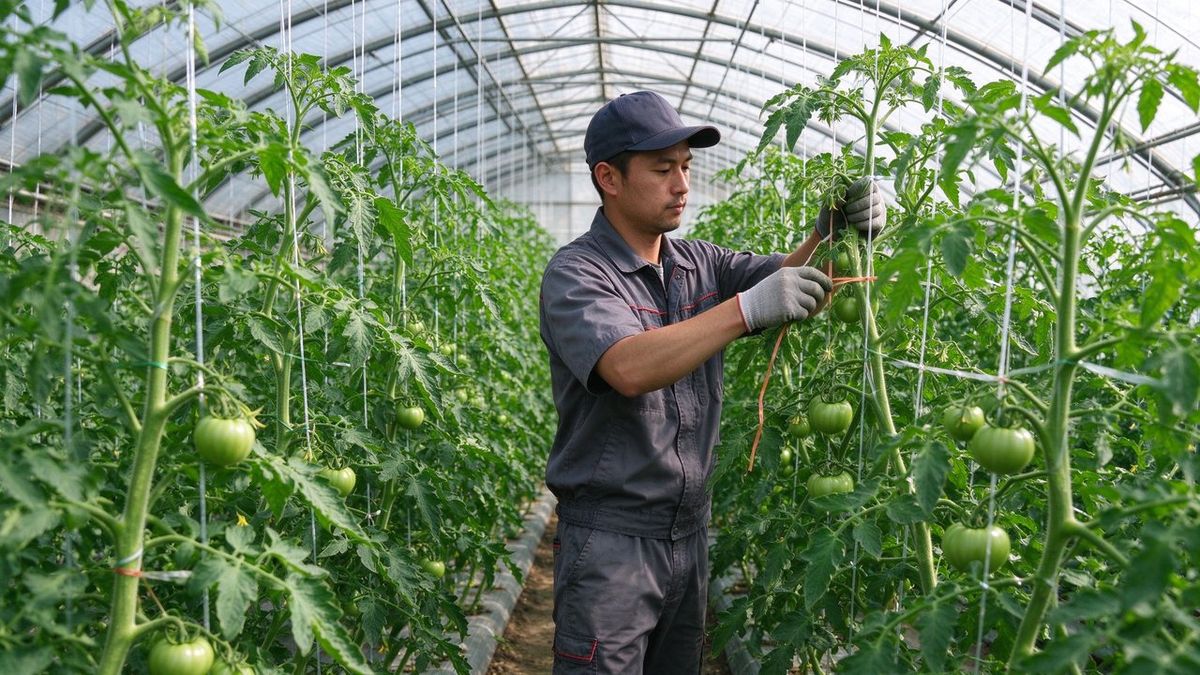
Pruning and fruit thinning are the disciplines that convert a vigorous melon vine into a crop of marketable fruit. Left unpruned, a melon plant produces 10 to 15 small, poor-quality fruit; a pruned plant produces one or two large, sweet, well-netted fruit. The labour cost of pruning is 8 to 12 hours per 100 m² per cycle, but it raises average fruit weight by 50 per cent and increases Brix by 1.5 to 2.0 degrees. Pruning is not optional in greenhouse melon; it is the production system.
Single-Stem Training
Greenhouse melon is trained to a single main stem tied to a vertical string from overhead wire. All lateral shoots below the fruit-set node are removed when they reach 5 to 8 cm long; this is done weekly. The main tip is not pinched until the fruit is set and reaches tennis-ball size. Below the fruit, 8 to 10 leaves are retained to feed the root system; above the fruit, 12 to 15 leaves are retained as the sugar source for the developing fruit.
After fruit set, two lateral shoots are allowed to develop above the fruit, each tipped at 5 to 6 leaves. These laterals provide extra photosynthate and shade the fruit from direct sun. Tendrils are removed weekly because they waste energy and tangle neighbouring vines. The goal is a clean vertical column of leaves, 30 cm wide, with fruit hanging below the leaf canopy where air circulation dries the rind.
Fruit Set and Thinning
Female flowers appear at nodes 7 to 10 on laterals, or on the main stem at nodes 15 to 20. The first female at nodes 5 to 6 is removed because it produces a small, low-quality fruit. The second or third female is the chosen fruit. Hand pollination is performed in the morning; the chosen female is tagged with a coloured band for harvest dating. Any other female flower that opens on the plant is pinched within 24 hours.
Fruit thinning continues after set. If two fruit have set on the chosen node, the smaller one is removed when both reach egg size. Only one fruit is allowed per plant in vertical systems; two fruit are permitted on vigorous grafted plants, but only if they set within 3 days of each other so they develop at the same rate. A late-set fruit never catches up and becomes a cull at harvest.
Leaf Management and Source-Sink Balance
Each fruit needs 15 to 20 functional leaves. If pruning removes too many leaves, Brix drops; if too few leaves are removed, the canopy is dense and disease-prone. A weekly walk removes yellow lower leaves and any leaf shading the fruit itself. Fruit should hang in the dry air channel, never touching a leaf, because leaf contact causes rind blemishes and botrytis.
After fruit reaches full size (around 30 days after pollination), the upper laterals are tipped to stop vegetative growth. This pushes all remaining photosynthate into the fruit. Removing the growing tip also reduces the height of the plant, which lowers wind drag on the trellis and prevents the string from pulling out under fruit weight. The fruit is slung into a nylon support bag once it reaches 200 g; an unslinged fruit pulls itself off the vine at 1 kg.
Pruning Hygiene and Labour Efficiency
Pruning tools are sanitised between bays with 70 per cent alcohol or 1 per cent Virkon. Dirty pruners transmit Tobacco mosaic virus and Cucumber mosaic virus between plants. Workers wear clean gloves; hands should not touch tobacco before a pruning shift, because TMV survives on hands for hours. Culled fruit and removed leaves are bagged immediately and removed from the greenhouse, never piled on the floor.
Labour planning: a trained worker prunes 400 to 500 plants per day, spending 30 to 45 seconds per plant. The pruning cycle runs weekly for 6 weeks after transplant. A 1,000 m² bay at 3 plants per square metre needs about 60 person-hours of pruning per cycle. This is 15 to 20 per cent of total crop labour, but it is the investment that turns a wild vine into a premium melon. Experienced growers schedule pruning for the morning, when plants are turgid and stems snap cleanly rather than tearing.
Pruning is the art of deciding what the plant will not do. A single stem, one or two chosen fruit, 15 to 20 source leaves, and a slung fruit support — that is the formula. Every removed lateral is a choice that concentrates the plant’s energy into the fruit that will be sold. The labour is repetitive but the payoff is measurable: heavier fruit, sweeter fruit, and a clean canopy that resists disease.


