
Fruit cracking costs melon growers 10 to 20 per cent of yield in irregular years. Cracks appear at the blossom end, around the stem, or as radial splits on the rind, and they let in Botrytis and Alternaria that rot the fruit within days. The mechanism is rapid internal expansion when water uptake suddenly outpaces rind elasticity. Cracking is worst when a dry spell is followed by heavy irrigation, when calcium nutrition is marginal, or when temperature swings exceed 15 degrees in a single day. Prevention is a water- and calcium-management discipline.
Cracking Mechanisms
Melon rind reaches its final thickness 25 to 30 days after pollination; after that, it is elastic but not expanding. If the fruit suddenly takes up a large volume of water, flesh cells swell faster than the rind can stretch, and the rind splits. This is why cracking spikes after a heavy irrigation following 3 dry days, or after a rain event on a plastic-mulched crop. Greenhouse crops are protected from rain but are exposed to the same risk when irrigation is poorly scheduled.
Calcium is the structural element that binds cell walls in the rind. Low calcium in the fruit tissue produces thin, inelastic rinds that crack at half the internal pressure of a well-fed fruit. Calcium moves in the xylem with transpiration; fruit transpires very little, so calcium arrives late and unevenly. This is why even well-fertilised crops show blossom-end cracking: calcium is in the root zone but not reaching the fruit.
Water Management to Prevent Splitting
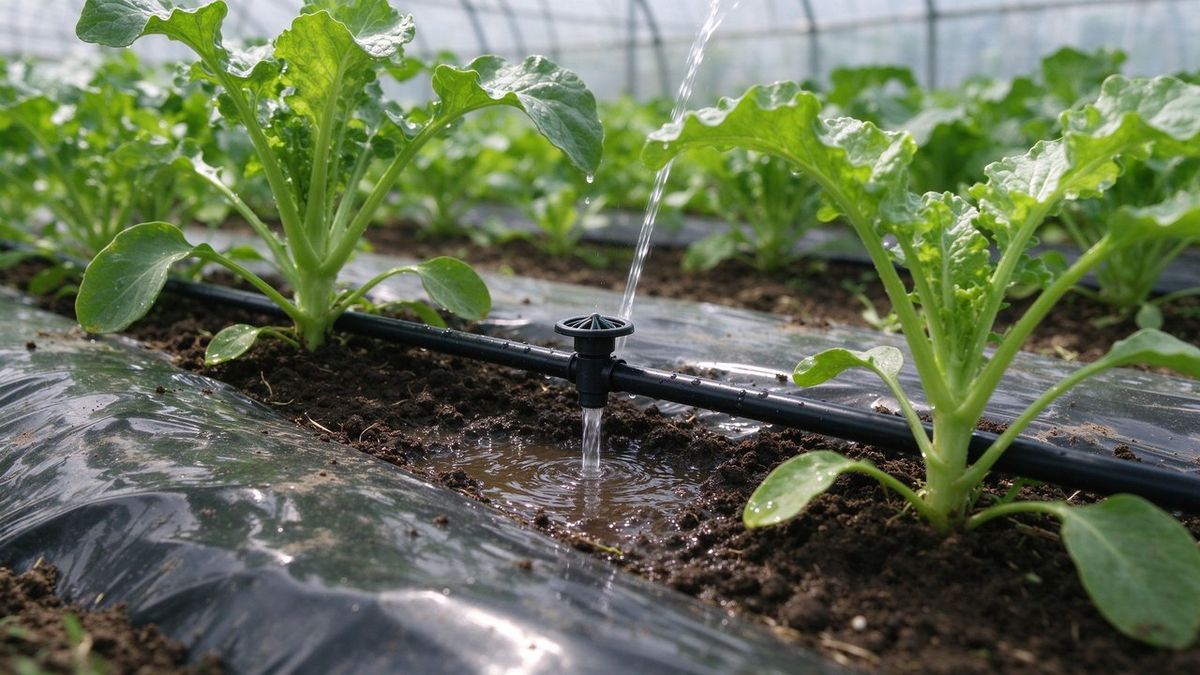
The rule is steady water, not boom-and-bust. Daily irrigation volume must vary by less than 20 per cent from one day to the next. A plant that receives 1.5 L one day and 3.0 L the next is set up to crack. Drip cycles are frequent and short: 6 to 10 cycles per day, 60 to 90 seconds each, rather than two long floods. Slab weight sensors help: weight should oscillate between 100 per cent field capacity and 75 per cent, never dropping below 70 per cent.
In the final 10 days before harvest, controlled mild water stress concentrates sugar, but this must not swing to drought. If slab weight drops below 65 per cent of field capacity, fruit will crack when irrigation resumes. The safe stress zone is 75 to 80 per cent of field capacity, not lower. After a cool cloudy week, irrigation must be ramped back over two days rather than restored in one step, because the root system has adapted to lower demand.
Calcium Nutrition and Rind Strength
Root calcium is held at 150 to 170 mg/L in the feed. But because fruit is a poor xylem sink, foliar calcium is essential: spray 0.4 per cent calcium nitrate (4 g/L) on the fruit surface every 7 to 10 days from 15 days after pollination until harvest. Direct coverage of the fruit is the goal; leaves alone do not deliver calcium to the rind. Foliar calcium sprays are applied in the morning so the fruit surface dries by noon.
Calcium competition from high potassium or magnesium in the feed can reduce calcium uptake. If potassium climbs above 300 mg/L, calcium is displaced on the root exchange sites. A feed ratio of K:Ca around 1.5:1 is the target. Tissue testing of the rind (not the leaf) every two weeks confirms: rind calcium should be 0.8 to 1.2 per cent dry weight. Below 0.6 per cent, cracking risk rises sharply.
Climate and Temperature Swings
Large diurnal temperature swings in the final weeks can trigger cracking, especially when nights are warm and days are hot. A 15-degree swing (18 night / 33 day) causes internal expansion and contraction cycles that fatigue the rind. Climate control aims to hold day temperature below 30 degrees and night above 18 degrees, narrowing the swing to 10 to 12 degrees. Shade screens on days above 32 degrees reduce leaf and fruit temperature peaks.
Humidity swings also matter. A dry afternoon followed by a wet night causes fruit to absorb moisture through the rind. Ventilation is managed so RH stays in the 65 to 75 per cent band day and night. Wet-wall cooling is used sparingly; misting directly over fruit is forbidden because rapid wetting and drying stresses the rind. Cultivar choice is the last line: thin-rind Galia types crack more than thick-rind cantaloupe types, so growing region and water discipline should inform cultivar choice.
Melon cracking is a water-balance disease. Steady daily irrigation, calcium delivered directly to the fruit by foliar spray, and a narrow diurnal temperature band prevent the sudden expansion events that split rinds. The most expensive irrigation mistake is not under-watering — it is the dramatic rewatering after a dry spell. Treat the fruit’s internal pressure as fragile, and the rind will hold.


