
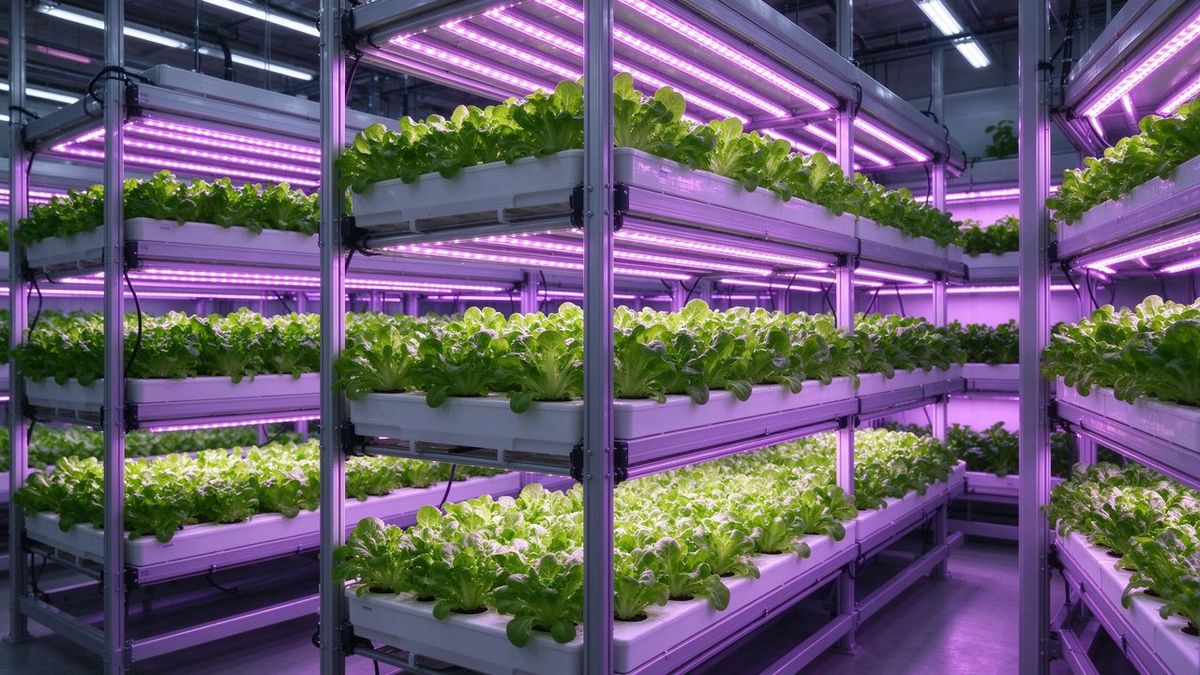
Kale has moved from a field brassica into a controlled-environment staple because it tolerates low temperatures, resists tipburn far better than lettuce, and delivers dense, nutrient-rich leaves on a 30 to 45 day cycle. In a CEA facility, kale is most often grown as a baby-leaf salad crop on floating rafts or as a full-size bunch crop on coco coir slabs, with target densities of 40 to 60 plants per square meter for baby leaf and 12 to 16 per square meter for bunching. Its main production risks are bolting under long warm days, anthracnose under wet foliage, and aphid buildup on the protected underside of leaves. Controlled lighting and fertigation solve most of these, but only if the grower sets the temperature and daily light integral correctly from day one.
Cultivar and Planting Density
Choose between curly-leaf types such as ‘Winterbor’ and ‘Redbor’ for bunch sales, and flat-leaf types such as ‘Lacinato’ (dino kale) for baby-leaf and processing markets. Red Russian and Siberian types tolerate the coldest winter nights, down to minus 5 degrees, but grow slowly. For CEA baby leaf, seed at 4 to 5 grams per square meter in broadcast trays, germinate at 20 degrees for two days, then drop the air temperature to 16 degrees to keep stems short.
For bunch kale on slabs, transplant seedlings at the four true-leaf stage into 10 centimeter coco slabs at 35 by 30 centimeter spacing. Density beyond 16 plants per square meter shades the lower canopy and triggers disease; below 10 plants, yield drops and leaves become coarse. Mark weekly sowings on the end of each slab so harvest blocks remain staggered and labor can be planned around a fixed five-day window.
Light Recipe and Daily Light Integral
Kale is a leafy brassica with a higher light requirement than lettuce: target a daily light integral of 14 to 18 mol per square meter for baby leaf and 18 to 22 mol for full-size bunches. Under sole-source LEDs, run 250 to 350 micromoles per square meter per second for 16 hours. Use a red-to-blue ratio of 3.5:1 to 4:1; adding 10 to 15 percent far-red at the end of the photoperiod slightly elongates petioles but deepens leaf color.
Photoperiod matters because kale is a long-day plant; continuous days above 14 hours combined with 22 degree nights trigger premature flowering in 35 to 45 days. Keep the photoperiod at 12 to 14 hours during winter production, and drop it to 10 to 12 hours in late spring to delay bolting. Track actual DLI with a quantum sensor at canopy level every two weeks; farmers often over-estimate light by 30 percent because the sensor sits too high.
Fertigation and Nutrient Targets
On coco slabs, deliver a full-strength brassica nutrient solution at an electrical conductivity of 2.2 to 2.5 mS/cm, pH 5.8 to 6.2. Kale needs a generous calcium supply, 180 to 220 mg/L, to prevent leaf edge necrosis, and a nitrate-to-ammonium ratio of 9:1. On floating rafts, hold EC at 1.8 to 2.0 mS/cm and dissolved oxygen above 6 mg/L, because raft kale roots are fully submerged and oxygen is the main limiting factor.
Irrigate by weight: water slabs to 80 percent of their dry weight on day one, then lift a sample slab daily until daily loss equals 2 to 3 liters per square meter. Run 2 to 3 irrigations of 200 mL per plant between 09:00 and 17:00, and stop three hours before lights-out so leaf surfaces dry. A 10 to 15 percent drainage rate protects against salt accumulation; slab leachate should measure within plus or minus 0.3 mS/cm of the feed.
Pest and Disease Pressure Points
Aphids, especially the cabbage aphid Brevicoryne brassicae, cluster on the youngest leaf folds and coat leaves with white waxy powder. Scout weekly and release Aphidius colemani at 1.0 per square meter, or apply potassium salts at 1 percent when populations exceed 5 per leaf. Diamondback moth is rare in protected culture but appears on open vents; use pheromone traps at two per 100 square meter to detect early flights.
Anthracnose and Alternaria leaf spot appear as tan necrotic patches when leaf wetness exceeds six hours. Prevent by keeping RH below 75 percent, running horizontal air flow at 0.4 m/s, and avoiding late-afternoon irrigation. Apply a copper hydroxide program at 1.5 g/L every 14 days during the wettest winter months, and remove lower outer leaves at each harvest to open the canopy.
Harvest and Value-Added Handling
Baby-leaf kale is cut at 10 to 15 centimeters tall, typically 25 to 30 days after sowing, with a sharp sanitized blade. Full-size bunch kale is picked leaf by leaf from the bottom up, taking three to four outer leaves per plant per week for four to six weeks. Bunches of 250 to 300 grams should be immediately hydro-cooled to 1 degree Celsius to remove field heat and extend shelf life to 14 to 18 days.
Yields typically run 4.0 to 5.5 kilograms per square meter per year from baby-leaf tables and 8 to 12 kilograms from bunch slabs over a 60 day plant cycle. Track electrical energy per kilogram of dry matter; kale, with its high light demand, usually sits at 90 to 130 kWh per kilogram fresh weight under LEDs. Zhongtian Agricultural Technology supplies integrated LED racks, fertigation carts, and environmental controllers that hold the 14 to 18 mol DLI target and the 2.2 mS/cm feed recipe across multiple stacked layers.
Kale rewards the CEA operator who treats light, temperature, and calcium as a single recipe. A fixed DLI target, a 12 to 14 hour photoperiod, and disciplined air-flow prevent the two failure points, bolting and wet-foliage disease, and turn kale into a reliable high-density specialty crop.


