
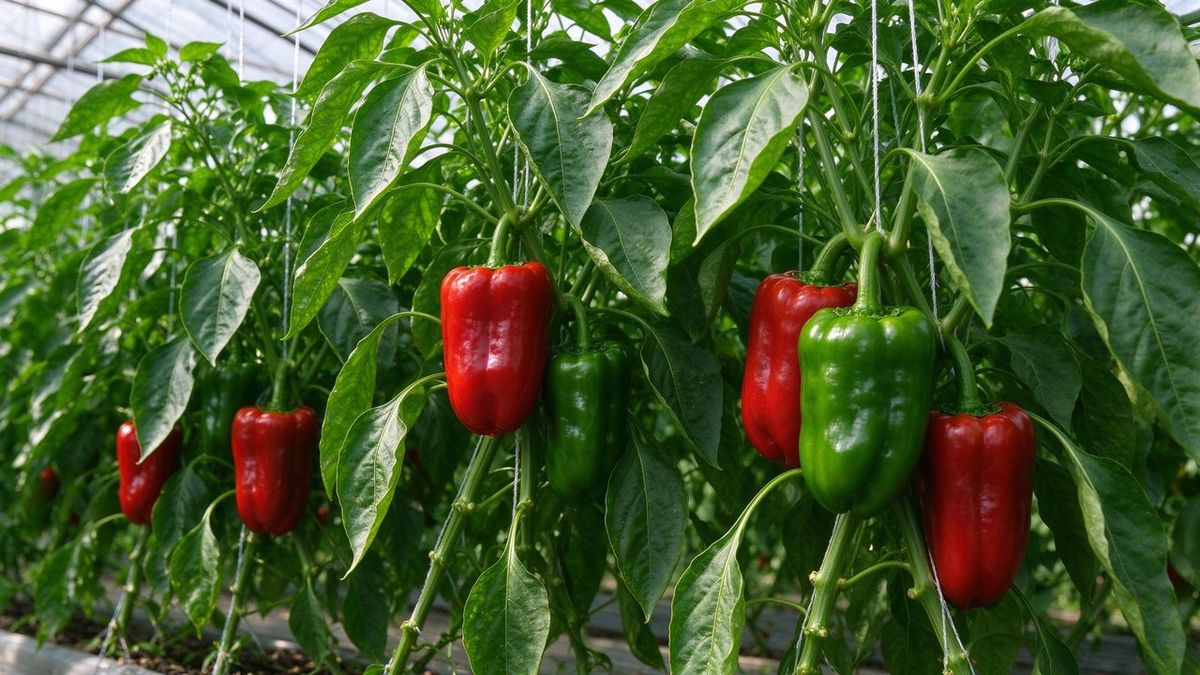
Sweet pepper variety choice sets the yield ceiling, fruit shape, colour, and shelf life for the whole season. Protected culture offers a wide range of blocky bell, lamuyo, and mini-bell hybrids, each bred for specific climate windows and market channels. Selecting the right variety means matching fruit type to market, disease package to local pressure, and heat or cold tolerance to the seasonal climate of the house.
Match Fruit Type to the Market
Blocky bell types produce 180 to 220 g fruit with 3 to 4 lobes, the standard wholesale pack. Lamuyo types are longer, 200 to 250 g, tapered, preferred in southern European and Asian retail. Mini-bell types at 80 to 120 g command a premium in salad packs. Decide the pack size before choosing any hybrid.
Colour matters: green bell is the volume market; red, yellow, and orange command a 50 to 100 percent price premium but take 15 to 20 extra days on the plant and reduce total yield by 25 percent. Calculate price per square metre per day, not per fruit.
Disease Resistance Package
Insist on resistance to Tobacco Mosaic Virus (Tm-2), Potato Virus Y, and bacterial spot where endemic. Resistance to Phytophthora root rot is essential in recirculating systems. Most modern hybrids carry a multi-virus resistance stack; cheap seed without it will fail in year two once virus builds in the house.
Look for intermediate resistance to powdery mildew and Botrytis on the stem. Resistance is never absolute; it delays outbreak by 7 to 10 days and reduces lesion area by 50 percent. Combine with the standard biocontrol programme rather than replacing it.
Heat and Cold Tolerance
Summer-grown sweet pepper needs heat-tolerant hybrids that set fruit above 28 degrees. Standard hybrids abort 60 percent of flowers above 30; heat-tolerant types abort only 20 percent. Choose heat-tolerant for May to October planting.
Winter-grown houses below 18 degrees at night need cold-tolerant hybrids that set fruit at 16 to 18 degrees. These yield 15 percent less in summer but hold the crop through short days. Match the hybrid to the average low temperature of the coldest month, not the annual average.
Yield, Shelf Life, and Internal Quality
Yield potential: 20 to 25 kg per square metre per year for top hybrids versus 15 to 18 for standard. Measure shelf life: a 200 g bell should hold firmness above 18 Newton for 14 days at 8 degrees and 90 percent RH. Poor varieties soften in 7 days and lose 10 percent at pack-out. Record average fruit weight per harvest box; a hybrid that drifts below 180 g by week 10 is losing its frame and should not be repeated next season.
Check wall thickness and cavity index. Thick-walled fruit (5 to 7 mm) ships well; thin walls (<4 mm) puncture in packing. Internal cavity size should be less than 50 percent of fruit diameter; large cavities cause hollow fruit. Taste-test: brix above 6 percent for red sweet pepper is the retail premium threshold.
Trial Before Committing
Grow three competing hybrids on 50 m2 strips in the same block. Record weekly yield, fruit weight, grade-A percentage, disease pressure, and shelf life at day 10. After one season, pick the winner for the next year’s full planting.
Seed cost runs 0.8 to 1.5 euro per seed; at 2.5 plants per square metre, that is 2.0 to 3.8 euro per square metre. A 10 percent yield gain pays back 5 to 8 times the seed premium. Zhongtian Agricultural Technology runs a variety trial strip in every block every season, so variety choice is data-driven rather than catalogue-driven.
Variety selection is the highest-leverage decision in sweet pepper. Start from the market pack, add disease and climate tolerance, validate with a strip trial, and choose by price per square metre per day rather than by catalogue picture.


