
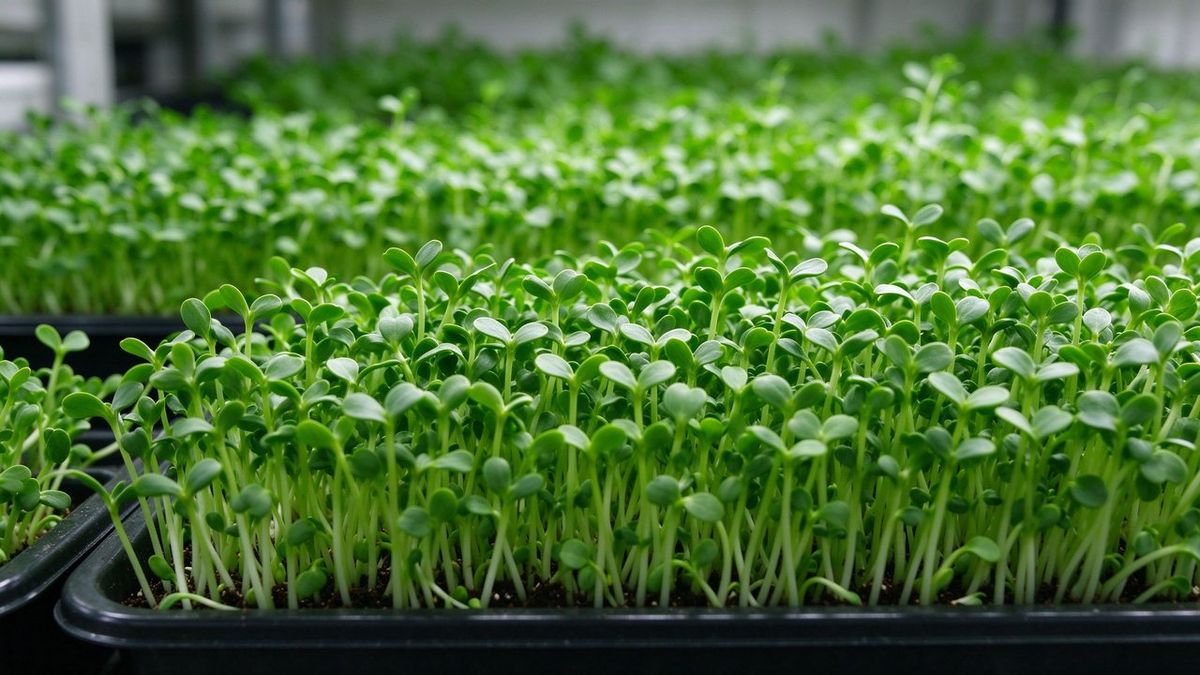
Microgreens are edible seedlings harvested at the cotyledon or first true-leaf stage, 7 to 14 days after sowing, and they are grown indoors on stacked vertical racks under sole-source LEDs. A vertical microgreen operation can produce 15 to 25 kilograms per square meter per week on a 100 square meter floor footprint, because the usable growing area is multiplied by 6 to 10 shelf layers. The economics turn on three levers: light uniformity, water chemistry, and hygiene. Because microgreens are eaten raw, every step from seed to clamshell is governed by food-safety rules, and the most common failure is post-harvest rot from poor drying.
Crop Selection and Seed Rates
Popular microgreens include pea shoot, sunflower, radish, broccoli, mustard, kale, basil, amaranth, and beet. Pea and sunflower are the highest-yielding at 4 to 6 kilograms per tray of 30 by 60 centimeters; brassicas and mustards yield 2.5 to 3.5 kilograms. Color-mixed specialty trays such as rainbow chard or opal basil command a price premium. Sow by weight: pea 200 grams per tray, sunflower 180 grams, radish 120 grams, broccoli 60 grams, basil 40 grams.
Pre-soak hard seeds such as pea, sunflower, and beet for 8 to 12 hours at 20 degrees to halve germination time. Treat brassica seeds with hot water at 50 degrees for 20 minutes to reduce black-leg and Alternaria, and treat all seed with a dilute hydrogen peroxide dip at 3 percent for 5 minutes before sowing. Use only seed rated for sprout or microgreen production; field-grade seed carries higher pathogen load.
Vertical Rack and LED Recipe
Racks are built from food-grade aluminium or powder-coated steel, 1.2 meters wide and 2.4 meters long, with 30 to 35 centimeters between shelves. Each shelf carries a 1.2 by 2.4 meter flood tray or a series of 30 by 60 centimeter trays. LEDs are mounted 20 to 30 centimeters above the canopy at 200 to 300 micromoles per square meter per second, with a red-to-blue ratio of 3:1 and 5 to 10 percent green to improve color perception. Photoperiod is 12 to 16 hours.
Daily light integral should be 8 to 12 mol per square meter for brassicas and 12 to 15 mol for pea and sunflower. Measure at canopy level with a quantum sensor every two weeks; light output falls 15 to 20 percent over 30,000 hours. Run racks on 400 to 500 watts per square meter of shelf area; energy typically consumes 25 to 35 percent of operating cost. Use a timer aligned to a 16 hour on, 8 hour off cycle, and pre-cool the room to 20 degrees before lights on.
Growing Medium and Irrigation
Use a thin 1 to 2 centimeter mat of coco coir, hemp, or biodegradable paper. Mats are preferred over loose soil because they eliminate grit and root contamination. Flood trays for 3 to 5 minutes twice per day, submerging the mat to 5 millimeters; drain completely so no standing water remains. Keep the room at 20 to 22 degrees Celsius and relative humidity at 60 to 70 percent.
Nutrient solution is dilute: electrical conductivity 1.0 to 1.4 mS/cm, pH 5.8 to 6.2. Many growers water only with plain RO water for the first 5 days and switch to weak feed at day 6. Stop irrigation 8 to 12 hours before harvest so foliage is dry. Wet microgreens in a clamshell rot within 48 hours; dry foliage extends shelf life to 7 to 10 days.
Food Safety and Sanitation
Microgreens are a recognized food-safety risk because they are eaten raw and grown in warm, humid conditions. Test irrigation water monthly for E. coli and coliforms; the water must meet potable standards. Require all staff to wear hairnets, gloves, and clean lab coats, and pass through a hand-wash and air-currier on entry. Disinfect trays with 0.5 percent peracetic acid between every cycle; never reuse mats.
Pathogens to watch include Salmonella and E. coli on seed, and Pythium on wet mats. Treat seed with a 10 percent bleach soak for 10 minutes followed by three rinses for high-risk crops. Keep the germination room at 100 percent RH for the first 48 hours, then drop RH to 65 percent to discourage fungal growth. Inspect every tray before harvest; any tray with mold, slime, or off-odor is rejected.
Harvest, Packing, and Yield
Cut at the soil line with a sanitized knife when cotyledons are fully expanded and the first true leaf is just emerging, usually 8 to 12 days for brassicas and 12 to 16 days for pea and sunflower. Cut in the packing room at 15 degrees to keep the product cold. Pack into vented clamshells at 100 to 150 grams; do not over-pack because bruising accelerates rot. Seal with a breathable film and label with harvest and pack dates.
Yield is typically 15 to 25 kilograms per square meter of shelf per week across 8 to 10 harvest cycles per month. Track energy per kilogram; well-run systems hit 60 to 90 kWh per kilogram. Plan 6 to 10 shelf layers and rotate blocks so one layer is sown, one germinating, one growing, and one harvesting at all times. Zhongtian Agricultural Technology supplies multi-tier rack systems, LED bars with tunable spectrum, and flood-tray irrigation controllers that hold the 200 to 300 micromole recipe and the 1.2 mS/cm feed automatically.
Microgreens are the densest indoor crop available, but they are unforgiving on hygiene and drying. A fixed seed rate, a 12 mol DLI LED recipe, dilute 1.2 mS/cm feed, strict seed sanitation, and a dry pre-harvest window turn a stacked rack into a reliable premium weekly revenue line.


