
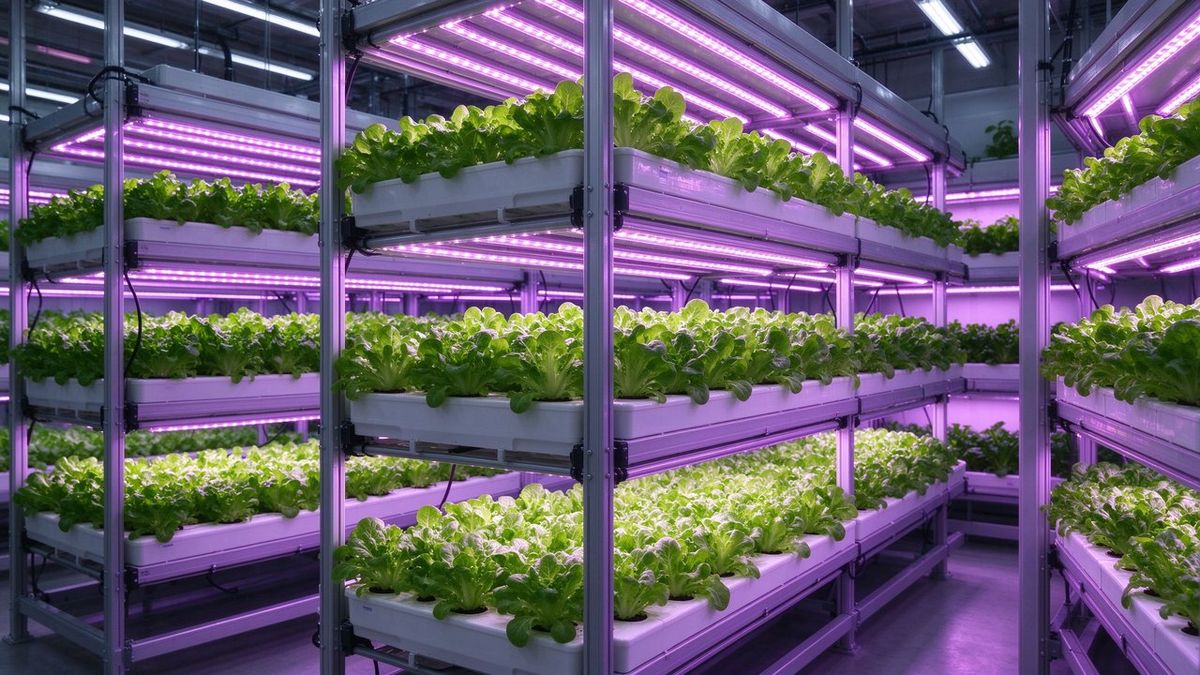
Greenhouse strawberry in high-latitude or winter production zones needs 12 to 16 moles of photosynthetically active radiation per square metre per day. On short cloudy days the glasshouse delivers only 6 to 8 mol, and fruit set, runner suppression, and harvest speed suffer. LED top-lighting has replaced high-pressure sodium because it delivers a tunable spectrum, runs at 2.7 micromoles per joule, and emits half the radiant heat. A properly tuned LED programme raises early-season yield by 20 to 30 per cent without softening fruit or stretching internodes.
Spectrum and Photon Density Targets
Strawberry responds best to a red-blue ratio of 4:1 to 5:1, supplemented by 10 to 15 per cent green for canopy penetration. A photon flux density of 120 to 150 micromoles per square metre per second at canopy level is the recommended supplemental level; pushing above 200 micromoles produces leaf bleaching and runnering. LED fixtures are mounted 4.0 to 4.5 metres above the canopy on a 2.5 m grid spacing, so uniformity at canopy reaches 85 per cent or better.
Far-red at 730 nm is added at 5 to 10 per cent of total photons to prevent compactness and improve truss extension, but excessive far-red causes elongated petioles and weak fruit stalks. Warm-white diodes at 3000 K are preferred over cool-white 6500 K because they maintain fruit flavour and anthocyanin development. Spectra are tuned by cultivar: ‘Albion’ tolerates higher blue, while ‘Camino Real’ prefers the warmer end to avoid tip burn.
Photoperiod and Lighting Hours
Supplemental lighting runs only when outside PAR drops below 200 micromoles per square metre per second, typically from mid-October through mid-March. The daily light integral target is 14 to 16 mol/m²/day. Lighting is scheduled as a 14-hour day: lights come on at 06:00 and off at 20:00, with daylight turning LEDs off automatically. Everbearing crops are lit at 16 hours through winter to maintain continuous flowering, but short-day forced crops drop to 12 hours once flower initiation is complete.
Night interruption at 22:00 to 02:00 with low-intensity red light at 30 micromoles is used in short-day cultivars to delay flowering until the planned forcing date. This is a precise tool: a 20-minute interruption error can shift harvest by three to five days. Light recipes are stored in the climate computer and adjusted by accumulated light integral rather than by clock, so dull cloudy days receive longer lamp-on periods than bright winter days.
Heat, Power, and Canopy Interaction
LEDs radiate less heat than HPS, so a small rise in root-zone heating is needed. Root-zone pipes run at 38 to 42 degrees Celsius supply, holding substrate at 16 to 18 degrees Celsius, two degrees warmer than in HPS-heated bays. This keeps root activity high during long lamp-on hours. Leaf temperature under LEDs is measured weekly with an infrared thermometer; target leaf temperature is 2 degrees Celsius above air temperature, never more than 4 degrees, or photosynthesis collapses.
Electrical design is planned at 150 to 180 watts per square metre of lamp load, with three-phase circuits and separate control zones. A 10,000 m² greenhouse draws 1.6 MW at full load, so power factor correction units are required. Lamp drivers are rated IP66 because humidity in strawberry bays reaches 75 per cent. Fixtures are washed every 60 days; dust accumulation cuts light output by 12 to 15 per cent per quarter and silently steals yield.
Yield, Fruit Quality, and Energy Economics
Trials show LED supplementation advances first harvest by 7 to 10 days, raises early marketable yield by 1.2 to 1.5 kg per square metre, and increases average berry weight by 2 to 3 g. Fruit firmness is preserved or slightly improved because LEDs lack the infrared load that softens fruit under HPS. Soluble solids stay at 8.5 to 9.5 degrees Brix, equal to unsupplemented summer fruit.
The payback period for a 1.6 MW LED retrofit is typically 2.5 to 3.5 years, driven by higher early-season prices when winter berries sell at two to three times summer rates. Energy monitoring is done per lamp zone: if a zone’s daily kWh per mol delivered rises by 10 per cent over 12 months, drivers are inspected and diodes replaced. Crop scouting for light leaf burn shows up as pale scorching on the upper leaf surface; this is corrected by reducing blue fraction by 5 per cent rather than by lowering overall PFD.
LED supplementation is not simply more light: it is a tuned recipe of spectrum, photon density, and photoperiod matched to cultivar and daily light integral. When LEDs are paired with root-zone heating and daily light-integral control, winter strawberry becomes a high-margin crop rather than a survival exercise. The economics favour growers who measure, log, and tune weekly rather than installing lamps and forgetting them.


